📖 Lesson content
Summary
When building applications with multiple tools, you need to handle scenarios where Claude might need to call several tools in sequence to answer a single user question. For example, if a user asks "What day is 103 days from today?", Claude needs to first get the current date, then add 103 days to it.
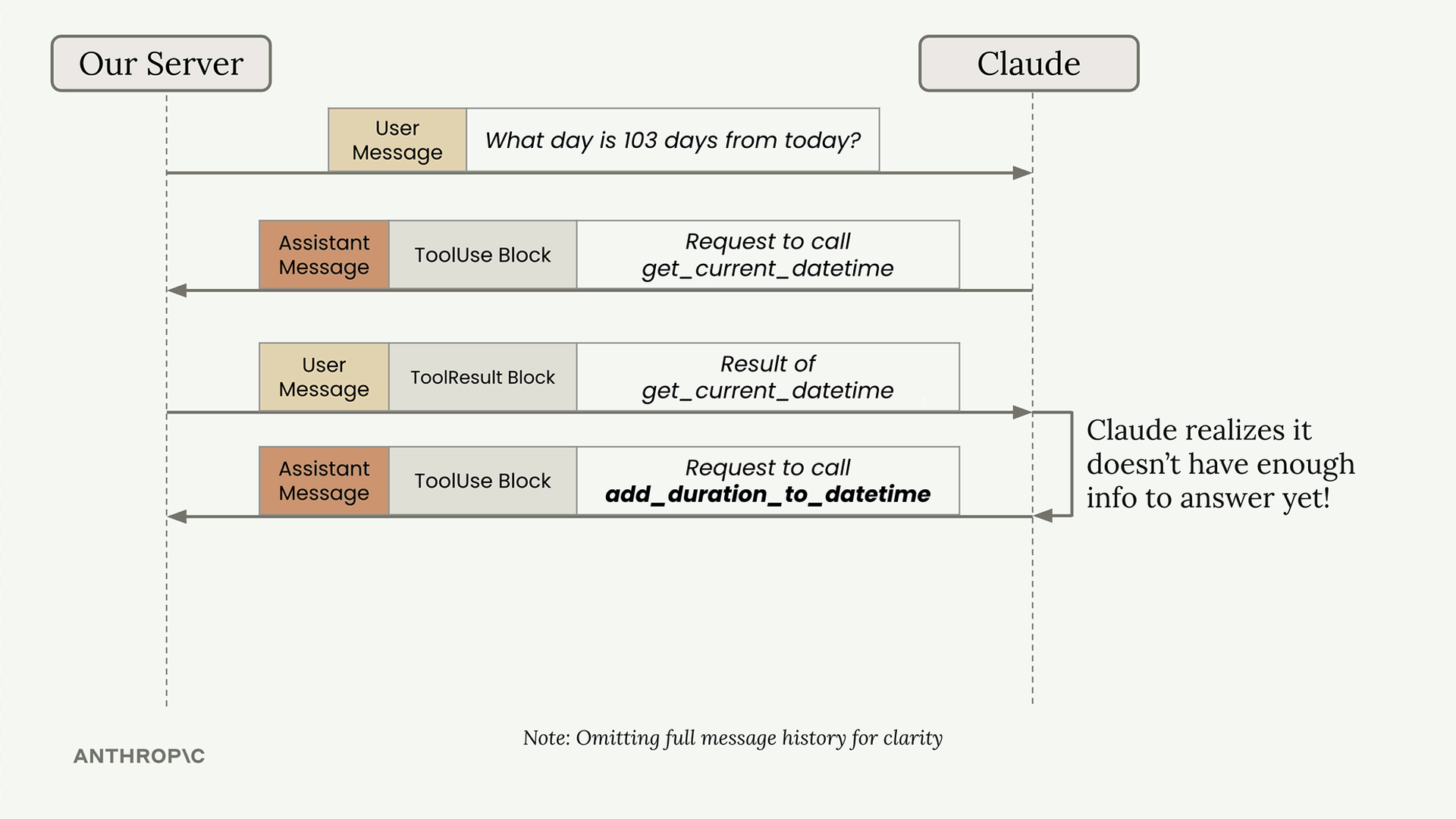
This creates a multi-turn conversation pattern where Claude makes multiple tool requests before providing a final answer. Your application needs to handle this automatically.
The Multi-Turn Tool Pattern
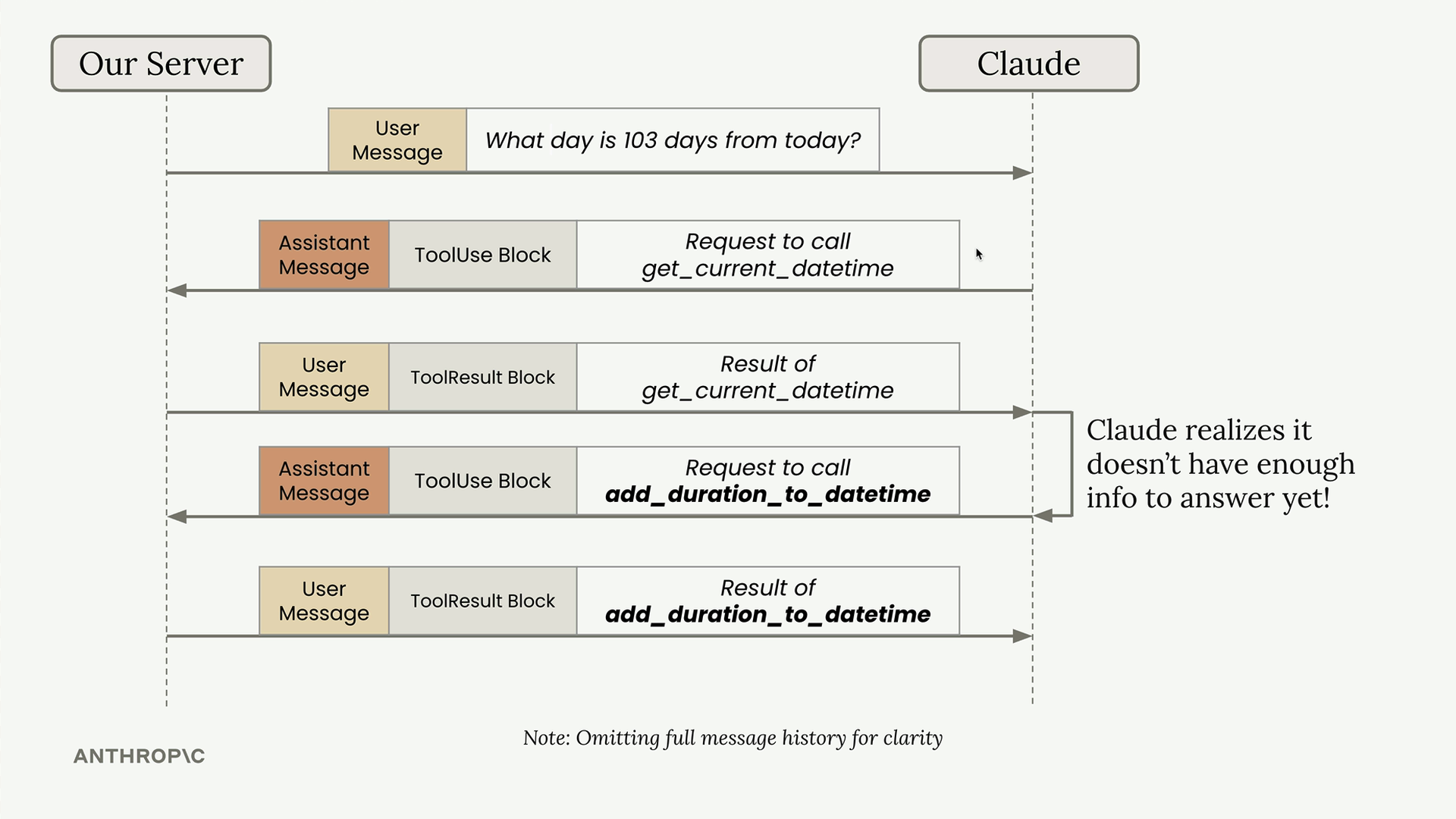
Here's what happens behind the scenes when Claude needs multiple tools:
- User asks: "What day is 103 days from today?"
- Claude responds with a tool use block requesting
get_current_datetime - Your server calls the function and returns the result
- Claude realizes it needs more information and requests
add_duration_to_datetime - Your server calls that function and returns the result
- Claude now has enough information to provide the final answer
Building a Conversation Loop
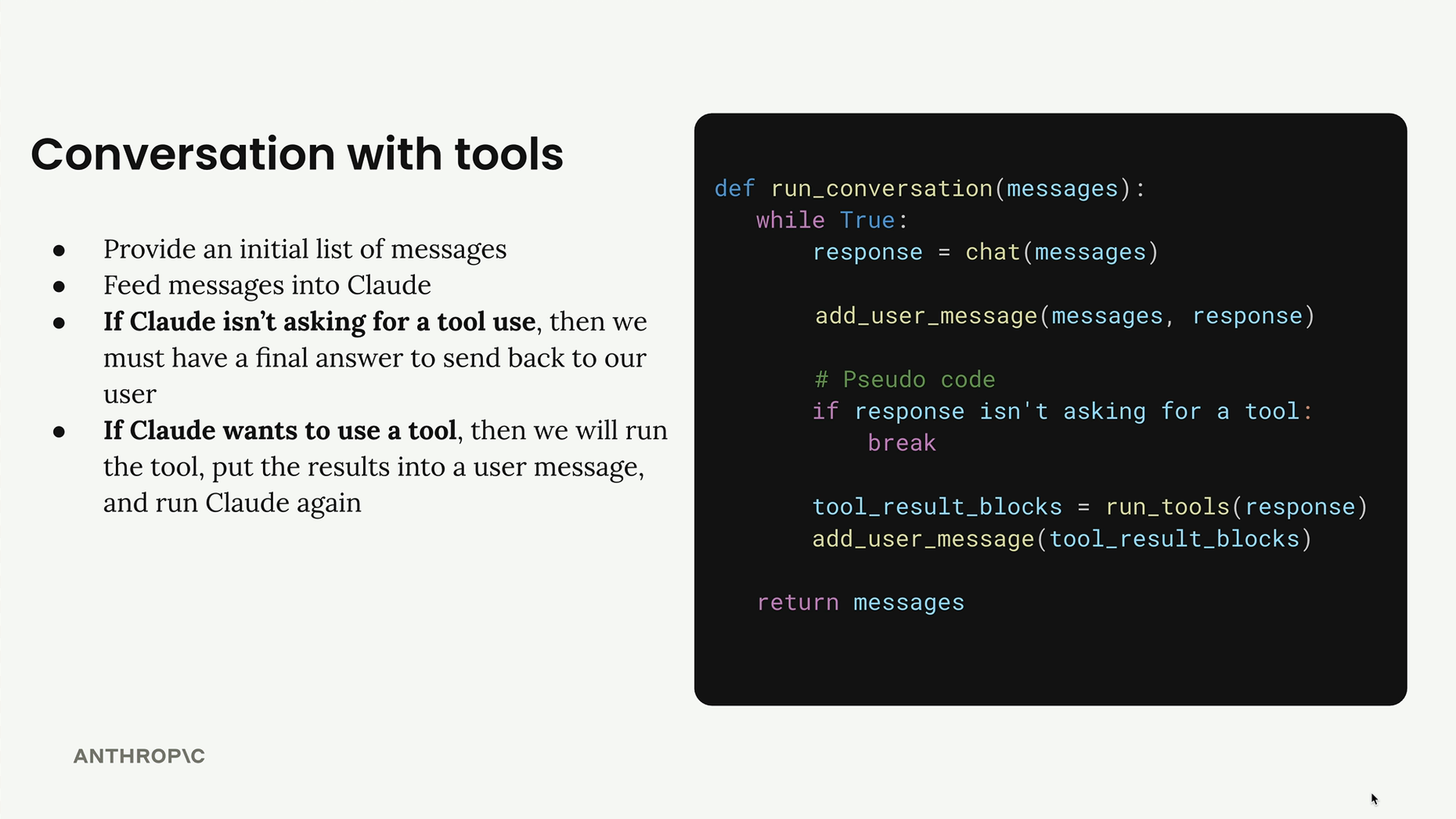
To handle this pattern, you need a conversation loop that continues until Claude stops requesting tools:
def run_conversation(messages):
    while True:
        response = chat(messages)

        add_user_message(messages, response)

        # Pseudo code
        if response isn't asking for a tool:
            break

        tool_result_blocks = run_tools(response)
        add_user_message(tool_result_blocks)

    return messages
Refactoring Helper Functions
Before implementing the conversation loop, you need to update your helper functions to handle multiple message blocks properly.
Updating Message Handlers
Your add_user_message and add_assistant_message functions currently assume they're always working with plain text. Update them to handle full message objects:
from anthropic.types import Message

def add_user_message(messages, message):
    user_message = {
        "role": "user",
        "content": message.content if isinstance(message, Message) else message
    }
    messages.append(user_message)
This allows you to pass in either a string, a list of blocks, or a complete message object.
Updating the Chat Function
Modify your chat function to accept a list of tools and return the full message instead of just text:
def chat(messages, system=None, temperature=1.0, stop_sequences=[], tools=None):
    params = {
        "model": model,
        "max_tokens": 1000,
        "messages": messages,
        "temperature": temperature,
        "stop_sequences": stop_sequences,
    }

    if tools:
        params["tools"] = tools

    if system:
        params["system"] = system

    message = client.messages.create(**params)
    return message
Extracting Text from Messages
Since the chat function now returns full messages instead of just text, add a helper to extract text when needed:
def text_from_message(message):
    return "\n".join(
        [block.text for block in message.content if block.type == "text"]
    )
This function finds all text blocks in a message and joins them together, which is useful when you need to display the final response to users.
Why These Changes Matter
These refactoring steps prepare your code for the reality of tool-enabled conversations:
- Multiple blocks per message - Claude's responses can contain both text and tool use blocks
- Flexible message handling - Your functions can now work with various message formats
- Full message preservation - You maintain all the information Claude provides, not just the text portions
- Tool list support - Your chat function can now receive and use multiple tools
With these foundations in place, you're ready to implement the full conversation loop that handles multiple tool calls automatically, creating a seamless experience where Claude can use whatever tools it needs to answer user questions completely.
Downloads
🔁 Related lessons
- Next: Implementing multiple turns
- Previous: Sending tool results
- Same section: Making a request · Multi-turn conversations · Chat exercise
- Part of paths: Path C
- Reference docs: Glossary · Skills atlas · By use-case
📚 Source & attribution
- Original Anthropic Academy lesson: https://anthropic.skilljar.com/claude-with-google-vertex/289178
- © 2025 Anthropic. Educational fair-use only.