📖 Lesson content
Summary
When working with Claude, writing a good prompt is just the beginning. To build reliable AI applications, you need to understand two critical concepts: prompt engineering and prompt evaluation. Prompt engineering gives you techniques for crafting better prompts, while prompt evaluation helps you measure how well those prompts actually work.
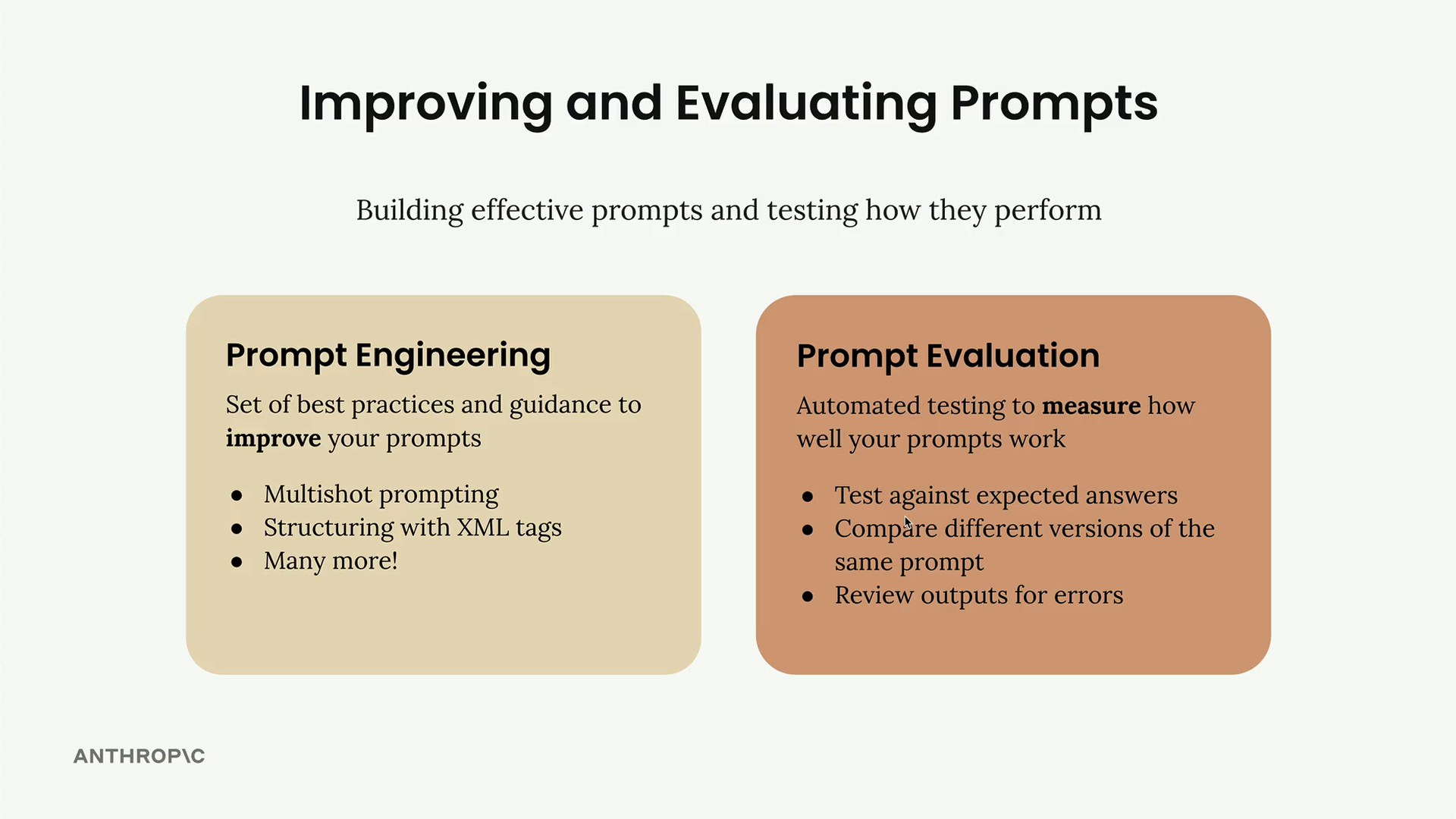
Prompt Engineering vs Prompt Evaluation
Prompt engineering is your toolkit for writing and improving prompts. It's a set of best practices that help Claude understand exactly what you're asking for and how you want it to respond. Think of it as the craft of prompt writing - techniques like multishot prompting, structuring with XML tags, and many other approaches we'll explore.
Prompt evaluation, on the other hand, is about measurement. It's automated testing that gives you objective metrics on whether your prompts are actually effective. Instead of guessing if your prompt works well, evaluation lets you:
- Test against expected answers
- Compare different versions of the same prompt
- Review outputs for errors
The Three Paths After Writing a Prompt
Once you've drafted a prompt, you typically face three options for what to do next:
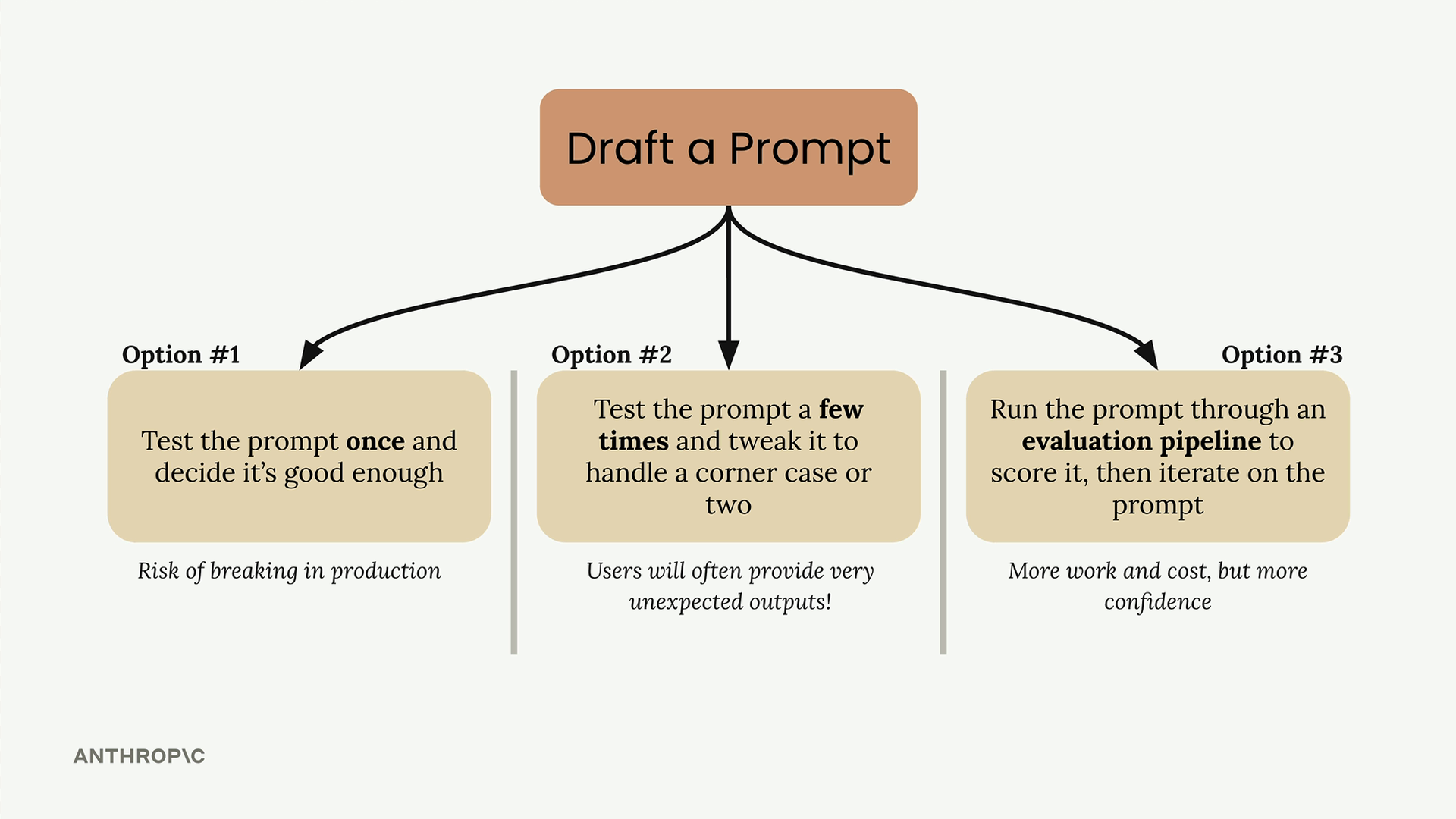
Option 1: Test the prompt once and decide it's good enough. This carries a significant risk of breaking in production when users provide unexpected inputs.
Option 2: Test the prompt a few times and tweak it to handle a corner case or two. While better than option 1, this approach still leaves you vulnerable because users will often provide very unexpected outputs that you haven't considered.
Option 3: Run the prompt through an evaluation pipeline to score it, then iterate on the prompt based on objective data. This requires more work and cost upfront, but gives you much more confidence in your prompt's reliability.
Why Most Engineers Fall Into Testing Traps
Options 1 and 2 are traps that all engineers fall into, myself included. It's natural to write a prompt for a serious application and not test it thoroughly enough. We tend to test with inputs that seem obvious to us, but real users will interact with your prompts in ways you never anticipated.
The solution is to embrace option 3: systematic evaluation. By running your prompts through proper evaluation pipelines, you get objective scores that tell you how well your prompt performs across a wide range of scenarios. This data-driven approach lets you iterate confidently and catch issues before they reach production.
Understanding evaluation first gives you the foundation to measure improvements as you apply prompt engineering techniques. Once you can reliably measure prompt effectiveness, you can experiment with different approaches and know definitively which ones work better.
🔁 Related lessons
- Next: A typical eval workflow
- Previous: Quiz on working with the API
- Same section: Overview of Claude Models · Accessing the API · Making a request
- Part of paths: Path C
- Reference docs: Glossary · Skills atlas · By use-case
📚 Source & attribution
- Original Anthropic Academy lesson: https://anthropic.skilljar.com/claude-in-amazon-bedrock/276731
- © 2025 Anthropic. Educational fair-use only.