📖 Lesson content
By the end of this lesson, you will be able to:
- Identify research and analysis tasks where Cowork's approach helps most
- Describe the kind of insight Cowork can surface at scale
- Frame tasks to find the signal, not just produce a summary
Estimated time: 10 minutes
Where the shape of the work matters
Overview
Both chat and Cowork can help with research and analysis. The difference is in the shape of the work that fits each.
Chat is excellent when the material fits in one conversation: you can paste it, discuss it, iterate turn by turn. Cowork fits better when the work has one or more of these qualities:
- Volume. Too many files to paste, or files too large to hold at once. Cowork reads them in place—no upload step, and you're not bounded by what fits in a single chat.
- Parallelism. When the task is "do the same analysis across N items," Cowork can process them simultaneously rather than one at a time.
- In-place computation. Cowork can run code on files where they live and write results back to disk. No upload and re-download cycle. The output is already where you need it.
None of these are things chat can't touch—they're things Cowork is built to handle more naturally when they're the shape of the work.
Examples of this shape
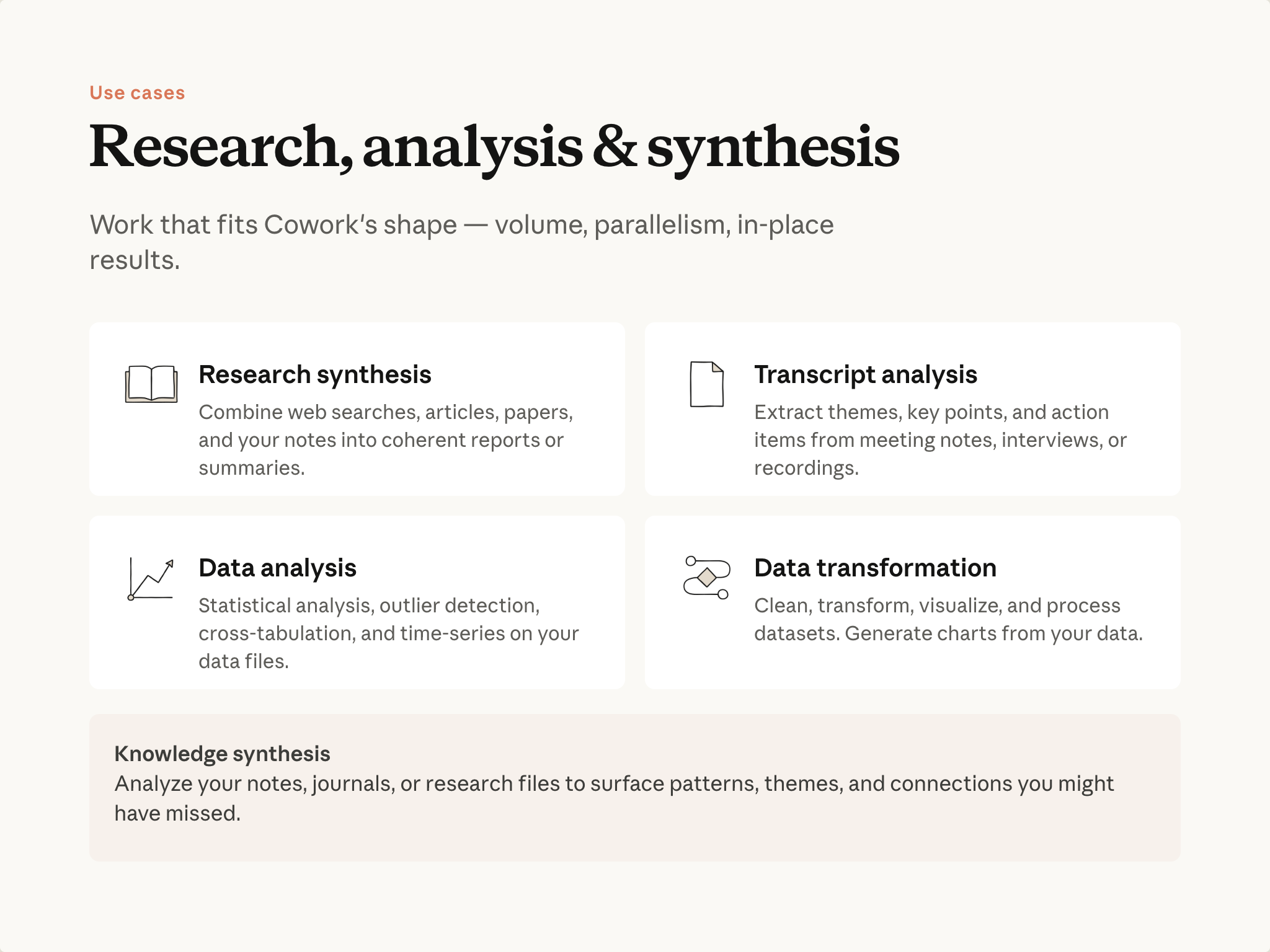
Research synthesis
Combine notes, articles, papers, and saved research into a coherent report. The value at scale comes from the cross-referencing: Cowork holds all the sources at once and can find connections you'd miss reading sequentially.
"Read everything in the research folder and write a synthesis report. Where do the sources agree? Where do they contradict each other? Flag any claim that only one source makes."
Transcript analysis
Extract themes, decisions, and action items from a collection of meeting notes, interviews, or recordings. A few transcripts fit fine in a chat. A large batch benefits from Cowork reading them in parallel—and in particular, finding the places they disagree.
"Read all transcripts in this folder. What did most people agree on? Who disagreed, and what do those people have in common?"
You might learn that the outliers share a trait. That's the insight buried at scale.
Data analysis
Statistical work on your data files: outlier detection, cross-tabulation, time-series. When the data lives on your drive, Cowork can work on it in place and write the results right back where you need them.
"For each customer in this file, calculate month-over-month usage change. Flag accounts with three consecutive months of decline and write a summary to the same folder."
Knowledge synthesis
Point Cowork at your own accumulated notes, journals, or project files and ask what patterns it finds.
"Read all my project notes from the last six months. What questions keep coming up? What did I decide in one project that contradicts what I decided in another?"
The framing: ask for the signal
The most useful prompts here aren't "summarize everything." They're the question you'd answer yourself if you had the time. Some examples of sharpening:
- "Summarize these transcripts" → "What did most people agree on? Who disagreed, and what do they have in common?"
- "Analyze this data" → "Which accounts are at risk based on the last three months? What's the common pattern?"
- "Review these papers" → "Where do these papers contradict each other? Which claims need the most caveats?"
The sharper question gets you something actionable.
Put it into practice
Think of a body of input you've been putting off working through—a folder of call notes, a dataset, a collection of saved research. Ask Cowork the sharp question. What's the outlier? What's the contradiction? What would change your decision?
What's next
In the next module: permissions, managing usage, and reviewing outputs before you act on them.
Feedback
Share your feedback here.
🔁 Related lessons
- Next: Permissions, usage, & choosing your model
- Previous: File & document tasks
- Same section: File & document tasks
- Part of paths: Path B
- Reference docs: Glossary · Skills atlas · By use-case
📚 Source & attribution
- Original Anthropic Academy lesson: https://anthropic.skilljar.com/introduction-to-claude-cowork/444171
- © 2025 Anthropic. Educational fair-use only.